All Posts By

stephen

[PODCAST] Dr. Kristen Schulz: Avoiding Exercise Burnout

By Insights

On this episode of the Healthy Wealthy and Smart Podcast, Jenna Kantor, DPT guest hosts and interviews Dr. Kristen Schulz, on how to make exercise fun. Kristen is a Physical Therapist and running coach who helps runners achieve their next PR without nagging injuries.

She is the creator of the Run Your Life Method, an online course providing a comprehensive and individualized approach for runners. Run Your Life’s mission is to provide runners the resources (prehab, rehab, strength training, recovery, nutrition, training, and mindset) they need to stay healthy, so they can enjoy the sport they love for their entire life.

In this episode, they discuss:

-How Kristen’s exercise routine has evolved into adulthood

-Kristen’s favorite go-to exercises -How variety in activities can help you avoid burnout

About Kristen:

Kristen is a Physical Therapist and running coach who helps runners achieve their next PR without nagging injuries. She is the creator of the Run Your Life Method, an online course providing a comprehensive and individualized approach for runners. Run Your Life’s mission is to provide runners the resources (prehab, rehab, strength training, recovery, nutrition, training, and mindset) they need to stay healthy, so they can enjoy the sport they love for their entire life. Kristen’s passion for her work stems from suffering a number of injuries herself. She ran competitively in high school and college with plans of continuing to improve her running times after college. However, injury after injury kept her from reaching her goals. It wasn’t until she started incorporating a comprehensive approach to running that she found herself able to run without constantly being injured. She finds great joy in being able to teach others how to do the same. Kristen has had the opportunity to live in many different parts of the country and currently resides in North Dakota. She graduated from Northern Michigan University with a degree in Exercise Science and Spanish, completed her Doctorate of Physical Therapy at Rocky Mountain University of Health Professions, and is a Certified Strength and Conditioning Specialist (CSCS).

About Jenna: 

Jenna Kantor (co-founder) is a a co-founder of the podcast, “Physiotherapy Performance Perspectives,” has an evidence-based monthly youtube series titled “Injury Prevention for Dancers,” is a NY SSIG Co-Founder, NYPTA Student Conclave 2017 Development Team, works with the NYPTA Greater New York Legislative Task Force and is the NYPTA Public Policy Committee Student Liaison. Jenna aspires to be a physical therapist for amateur and professional performers to help ensure long, healthy careers. To learn more, please check out her website: www.jennafkantor.wixsite.com/jkpt
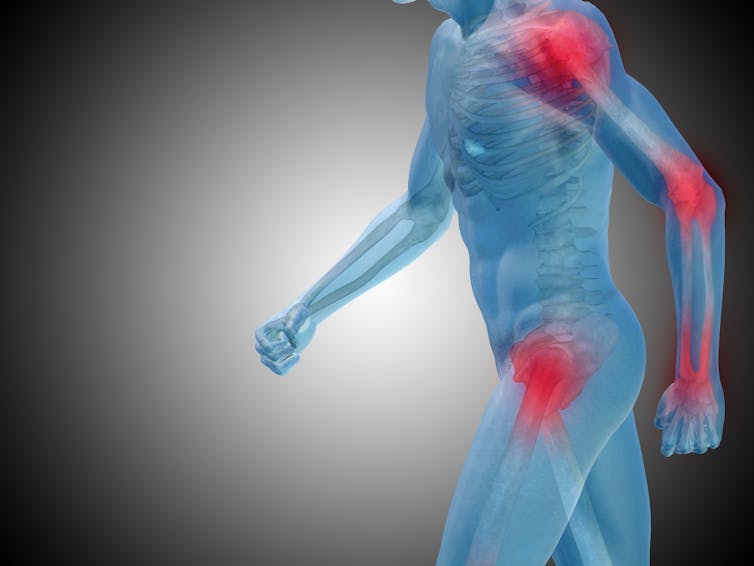
 

Unpacking pain: what causes it and why it’s hard to measure

By Insights
File 20181211 76971 17e3m1v.jpg?ixlib=rb 1.1
There’s a significant variation in pain sensitivity and tolerance.
Shutterstock

Antonia Wadley, University of the Witwatersrand and Peter Kamerman, University of the Witwatersrand

Pain is difficult to measure. Unlike using a thermometer to measure body temperature, a blood test to measure blood glucose, or a magnetic resonance imaging (MRI) scan to detect a tumour, there are no instruments or tests that objectively measure pain.

To understand why, one needs to understand what pain is.

Pain is a perception, and like other perceptions (such as happiness, sadness, anxiousness), it reflects the sum of a lot of external and internal information interpreted by our brains.

For example, we have a specialised part of our nervous system that responds to harmful or potentially harmful stimuli, such as heat from a hot stove and chemicals from a stinging nettle. This system relays information on the location (like the tip of your right index finger) and intensity (the paper cut vs cutting your fingertip off) of a harmful stimulus to the brain. This sensory input is called nociception (detection of noxious stimuli). But the brain doesn’t only rely on incoming nociceptive information to generate our perception of pain.

Rather, the brain mixes the sensory information with lots of other sources of information. This other information includes the context in which you were exposed to a harmful stimulus, your emotional state, and your past experiences.

In the context of all these variables, assessing the magnitude of someone’s pain is fraught.

Some of the variable factors

Context matters. For pain perception, context may reflect changes in a person’s:

  • attention – a person feels less pain if they are distracted,
  • psychological state – a person experiences more pain when they are anxious compared to when they are calm,
  • cultural norms – in many cultures it is frowned upon for men to overtly express pain,
  • if a person is sleep deprived – lack of sleep increases pain sensitivity, and
  • if a person is a woman – women are more likely to have chronic pain conditions than are men.

Past experience matters too. For example, if the last time a person felt a twinge in their lower back it developed into sciatica, with significant pain that took months of therapy to come right, the next time they experience a twinge in their back the person is likely to experience more anxiety and pain.
Pain, you see, isn’t an input to the body, rather pain is an output of the brain’s threat detection system.

Another major factor is a person’s current state of mind. They may rate a noxious stimulus differently from day to day, or even within a day. Indeed, from your own experiences, you might appreciate that pain associated with an injury isn’t constant throughout the day.

There’s also significant variation in pain sensitivity and tolerance between people.

There may be large differences in contextual and experiential influences affecting how pain is perceived differently by people. Added to these influences, the pain experience is further complicated by inherent biological differences in the nociceptive and pain perception systems caused by natural genetic variation.

So, how to measure?

If pain perception is so complicated, how on earth is it reliably measured? Well, it’s actually quite simple: just ask the person. The clinical adage, “a person’s pain is what they say it is”, describes the approach perfectly.

Scientists and clinicians do, however, try to standardise how people rate their pain using some simple scales. These can include scales that show various facial expressions associated with increasing pain, or asking people to rank pain from zero to 10. In all cases, scales are anchored at the extremes by the descriptors, “no pain”, and “the worst pain you can imagine/have ever experienced”.

But by translating a complex perception into a simple scale, important information can be lost, especially qualitative information about the nature of the sensation. For example, is the pain sharp, dull, aching, squeezing, shooting; or how the pain makes a person feel (worried, sad, anxious); and how it modulates behaviour (unable to do housework).

A simple scale of a complex perception also contributes to the high variability in ratings when ratings are repeated in the same individual, and biased ratings across individuals.

As scientists and clinicians working in the field of pain, we understand the limitations of our measurement tools, much like individuals who study diseases without objective diagnostic measures, such as depression and schizophrenia. We understand that the variability in our measurements is high and objectivity is low.

We have to work within these limitations to effect better pain management and to study the mechanisms of pain.The Conversation

Antonia Wadley, Lecturer in the School of Physiology, Faculty of Health Sciences, University of the Witwatersrand and Peter Kamerman, Professor in the School of Physiology, Faculty of Health Sciences, University of the Witwatersrand

This article is republished from The Conversation under a Creative Commons license. Read the original article.

[PODCAST] Martin Asker, MSc: Shoulder Injury in Overhead Athletes

By Insights

On this episode of the Healthy Wealthy and Smart Podcast, Dr Litzy welcomes Martin Asker on the show to discuss a handball injury case study.

Martin is a sports medicine therapist specialised in shoulders and biomechanics. He has worked with different elite European handball teams since 2000 and for the last 12 years with a special focus on youth and adolescent elite players. He works part time as clinical lead at a multidisciplinary sports medicine clinic in Stockholm, Sweden mainly seeing shoulder related problems and part time as a PhD-candidate at the Musculoskeletal & Sports injury Epidemiology Center (MUSIC) at Karolinska Institutet in Stockholm.

In this episode, they discuss:

-Teasing out subjective findings and when to refer for imaging

-How the acute:chronic workload ratio impacts young handball athletes risk for injury

-Essential and nonessential objective measurements that are relevant for return to sport

-The importance of strength and conditioning in end ranges of motion and return to throwing programming

The acute:chronic workload ratio is an important consideration for injury management as Martin stresses, “Being an on and off, on and off player, it won’t do anymore.”   Your clinical tests and measures need to be robust enough to translate to the sport setting because, “What we measure on the bench does not correlate to what happens when they are throwing.”   Framing your language surrounding a shoulder health maintenance program as being a performance enhancer will help improve compliance as Martin has found that, “They care, but they care more about the performance than injury prevention.”

Understanding the motivation behind why a youth athlete seeks care can help guide your patient education because, “They don’t see you when they are in pain, they see you when they can’t perform anymore.”

About Martin Asker:

Martin is a sports medicine therapist specialised in shoulders and biomechanics. He has worked with different elite European handball teams since 2000 and for the last 12 years with a special focus on youth and adolescent elite players. He works part time as clinical lead at a multidisciplinary sports medicine clinic in Stockholm, Sweden mainly seeing shoulder related problems and part time as a PhD-candidate at the Musculoskeletal & Sports injury Epidemiology Center (MUSIC) at Karolinska Institutet in Stockholm. The overall aim of his PhD project is to deepen the knowledge in shoulder function in elite adolescent handball players and the specific aim is to investigate risk factors for, and prevention of shoulder injuries in such population. He also has a special interest throwing biomechanics and its relationship to throwing performance and injuries. Martin is also a board member of the Medical Committee of the Swedish Handball Federation and part of the medical team of the Swedish youth-16 national handball team.


[WATCH] What Happens When We Mix Real Doctors, Big Data, and AI?

By Insights

Technology and “Big Data” are likely to be key drivers of the healthcare sector in the coming years with a number of exciting new technologies coming onboard. How will this technology move from concept into practical applications in medical practices?

Atul Butte, MD, PhD is the Priscilla Chan and Mark Zuckerberg Distinguished Professor and inaugural Director of the Bakar Computational Health Sciences Institute (bchsi.ucsf.edu) at the University of California, San Francisco (UCSF). Dr. Butte is also the Chief Data Scientist for the entire University of California Health System, with 17 health professional schools, 6 medical centers, and 10 hospitals.

He is also founder of three investor-backed companies: Personalis, providing clinical interpretation of whole genome sequences, Carmenta, discovering diagnostics for pregnancy complications, and NuMedii, finding new uses for drugs through open molecular data.

In this talk, he looks at the topic of technology, data and the interaction with healthcare professionals:


Physio Matters Podcast: The Elbow: Tennis & Otherwise with Val Jones

By Insights

Are you treating Tennis Elbow? This 60th episode of the Physio Matters podcast look the subject of Tennis Elbow:

This includes predisposing factors, triage, assessment, treatment, management, prognosis, prevention and more!

The team interviews Val Jones who is a hugely knowledgable upper limb specialist Physio from Sheffield who has helped to promote the ‘E’ in BESS (British Shoulder & Elbow Society) for many years.

Enjoy:

Don’t forget that you can use our 3D Joint ROM tool to measure Range of Motion (ROM) in the elbow highly accurately and in real-time

[READ] The Ultimate Low Back Pain Bible

By Insights

Looking for some reading material this festive season?

Australian Physiotherapist Michael Stizza from Upwell Health Collective has put together a 25 page e-book looking at the subject of low back pain.

According to Stizza:

“Musculoskeletal conditions have become the number one national health priority, affecting over 6.9 million Australians. More than half of these musculoskeletal problems are attributed to back pain, or injury. Low back pain is so common that it is predicted up to 85% of us will experience an acute bout of low back pain over our lifetime, with some of these progressing to recurring, or persistent problems”

To download the e-book then please click on the cover below:

Digital Kickstarter Package for new practices

By Insights

As a business, two of our passions are entrepreneurship and helping healthcare practitioners to adopt the use of technology in their practices. If you are recently graduated and planning to launch your own practice in 2019, then we have something for you:

We want to help new practices get online and embrace technology. To that end, we have developed a Practice Kickstarter package for clinicians who are planning to launch new practices in 2019.

Practice Kickstarter package comprising:

  • 3D Joint ROM kit comprising software, strapping and sensors for 12 months
  • .co.za domain registration for 12 months
  • 2 e-mail addresses for your practice
  • Basic website configuration with theme including copyright, privacy and anti-spam tools and pages
  • Assistance in setting up your Google My Business account and tips for securing Google Reviews
  • 1 hour free consultation for configuring and optimising your practice billing requirements
  • Assistance in setting up your profile in our “Movement Experts” directory
  • 12 month maintenance of your site including backups and social sharing buttons

The cost for this package is R4750

About 3D Joint ROM

Nominated for two innovation awards in 2018, shortly to be featured in one of the top international medical futurist publications and with a user base comprising academics, biokineticists, chiropractors and podiatrists, 3D Joint ROM is a must-have tool for the technology savvy medical practice.

The tool provides for accurate, real-time measurement of Range of Motion (ROM) for all joints with up to 36 different movement templates available.

Terms and Conditions:

  • Orders must be placed and paid-for in December 2018
  • This offer is only available to clinicians in South Africa
  • Basic website configuration comprises: Basic logo, home page, enquiry form, testimonial page and “about” page. For additional functionality and features, additional charges may be levied.

For more information on this offer, please e-mail marca@3djointrom.com


Measuring Proprioception / Kinesthesia Using 3D Joint ROM

By Insights

Often referred to as the “sixth sense” in humans,  Proprioception is defined as “the sense though which we perceive the position and movement of our body”.

It could further be defined as

“The awareness of the body in space. It is the use of joint position sense and joint motion sense to respond to stresses placed upon the body by alteration of posture and movement.” 

In the past, therapists have been utilised subjective analysis to see whether a patient is able to return a joint to a pre-determined position or starting point.

Therapists can now use the easy-to-set-up 3D Joint ROM tool to test and measure proprioception and feedback to patients in real-time. You can also use the tool to analyse trends – improvement / decline in Proprioception or Kinesthesia across multiple sessions and this could prove valuable in a medico-legal environment.

You can see 3D Joint ROM in action HERE or purchase it  through our online store. If you have further queries around the tool, you can e-mail marca@3djointrom.com

Measuring Quality of Movement using 3D Joint ROM

By Insights

While Range of Motion (ROM) is an important element to consider for clinicians, the ultimate goal is to measure Quality of Movement.

Our powerful reporting and graphing features allow a therapist to measure and monitor in real-time, the Quality of Movement in real-time.

  • Are the movements smooth or erratic?
  • Is the patient trying to compensate for pain or discomfort by moving the joint through one of the other planes
  • Can you as the clinician identify the exact moment that a patient experiences pain, record that pain marker and revert with objective data to show improvement in quality of movement?

The 3D Joint ROM tool provides a number of features to equip clinicians with the ability to measure the Quality of Movement to demonstrate outcomes or evidence based monitoring and improvement of quality of movement.

You can see 3D Joint ROM in action HERE or purchase it  through our online store. If you have further queries around the tool, you can e-mail marca@3djointrom.com