In this episode, the PodChat team -Craig Payne and Ian Griffiths. – talked with Annette Davis and discussed what the evidence tells us (and doesn’t tell us) about footwear and falls, explains the role of the Podiatrist in screening for falls risk and how to communicate effectively regarding this (making a reasonably solid case for all individuals of a certain age to be risk assessed regardless of why they are attending clinic to see you) and also the talks about the reasons that older individuals choose certain shoes and the challenges this can bring to the Podiatrist-patient interactions.
Enjoy!
Looking to measure Range of Motion for your patients? Don’t forget to check out our 3D Joint ROM product today.
While technology adoption amongst clinicians in South Africa remains slow, co-ordination between industry stakeholders is likely to contribute to a higher level of up-take in the coming years and ultimately improve the quality of healthcare data in the country.
This was one of the key comments from the recent “Practice Of The Future” event hosted by Dynamic Body Technology at the Wits University eZone recently. Participants in the workshop were exposed to a variety of topics including social media ethics and data handling for medical practitioners, medical animation, Google tools to enhance visibility of medical practices, sensor technology and 21stcentury learning environments.
“FitBit recently announced that it had recorded its 150 billionth hour of heart rate data and Discovery has over 110 million tracked events in their Vitality program – consumers are embracing the world of wearable and sensor technology but clinicians appear to be behind the curve in terms of embracing technology” says Dynamic Body Technology CEO Marc Ashton.
Constitutional and media law expert Avani Singh from Power Singh Incorporated – who addressed the audience on the subjects of social media and ethics around data handling in the healthcare environment – did however caution that the intersection of technology and healthcare throws up interesting legal challenges for clinicians to consider. “Technology is a clear enabler for the healthcare sector but clinicians, researchers, academics and healthcare companies themselves need to ensure that they understand the ethical requirements before they start to gather data or share information across technology platforms.”
Paula Barnard-Ashton who heads up the eZone in the School of Therapeutic Sciences at Wits University believes that investment in 21stcentury learning environments will facilitate greater adoption of technology in the coming years: “When we started the eZone project for therapeutic sciences, the lecturers were naturally wary. Now we have an environment where students are able to live stream with lectures over Skype from the hospital or clinical setting. Students and lecturers are trying out cutting edge sensor technology, 3D modelling, online collaboration and simulation that will prepare them for the changing world of work and to prove that we are on par with the private sector, our project came second at the recent ‘Learning Idols’ at the Learning Innovation Africa 2018 conference”
Dr. Tshepo P. Maaka – presenting medical animation on behalf of Cabblow Studios – made the observation that while using new and diversified technology to improve medical practices lags behind in its adoption, this should be viewed as both a challenge and an opportunity: “In a market like South Africa, the situation is compounded by the stratification and independence of how practices work. In addition, we have patients who have access to high-quality healthcare through government hospitals and clinics and through medical insurance companies, but who have challenges in understanding their insurance cover plans, their journey of accessing clinical services in a hospital maze, the complexities of the informed consent process for surgical procedures and the technicalities of the medical lingo. If clinicians and Occupational Health professionals begin to invest in technology and educational initiatives such as medical animation, we can begin to enhance healthcare service provision in practices through preventative measures and health promotion, where patients understand healthcare levels and services better and where we enhance waiting rooms experiences in South Africa.”
Dynamic Body Technology Chief Technology Officer Stephen Meyerowitz concludes: “I believe we need a mind-shift change: To democratise health sector, clinicians need to recognise that they are on the frontlines in terms of data gathering and by using technology they can share actionable insights with all stakeholders.”
In this episode the PodChatLive team talked with Ben Cormack.
Ben Cormack owns and runs Cor-Kinetic. He is a musculoskeletal therapist with a clinical background in sports therapy, rehabilitation, pain science & exercise stretching back 15 years. He specialises in a movement & exercise based approach with a strong education component and patient centred focus.
The interview covers what he believes are the key components to a successful rehab programme (and why they may fail), along with how we promote self efficacy, empower and motivate our patients and the evidence base behind strength work (and the differences between strength and load tolerance).
Don’t forget to check out our 3D Joint ROM product to measure Range of Motion (ROM) accurately and develop 3D models of your movement.
What are the key components when assessing and treating runners? Should your treatment of running injuries focus on glutes? How can your runners schedule their training to improve recovery?
Physiotherapists Tom Goom and David Pope answer your questions on how to assess and treat patients with running-related injuries, including:
The key concepts when assessing and treating running injuries
Gait retraining programs
The best ways to change running technique
Does gait retraining cause fatigue? – Is gait retraining suitable in painfree runners?
What are the most important elements to prevent injury in runners?
Scheduling to improve recovery from injury. When should your runner run, and when should they rest?
Can we increase leg stiffness when running? Does increasing leg stiffness reduce injury risk?
Strengthening for runners
Do glutes become underactive or “not fire properly”?
Does improving glute strength improve running mechanics?
Calf tears – how can you treat these?
What tests can you perform for your runners calves?
Do runners have “stiff hips”, and does it matter? – Can you help runners with meniscal tears? – How can you treat ITB syndrome?
Is barefoot running helpful or harmful?
Should we run in only 1 shoe if we want to win a race?
Physical Therapist Mike Reinold gives community members a test for Meniscus by bringing the knee to full deep knee flexion and full knee hyperextension.
According to Reinold: “With full knee flexion, the posterior aspect of the meniscus is engaged, and with full knee extension the anterior is engaged. This is often painful in people with meniscal pathology, but you could also have a mechanical block of the motion.”
Don’t forget that you can use our 3D Joint ROM tool to measure for Range of Motion (ROM) as well as Quality of Movement / Motion (QOM)
Shoulder replacement is a surgical procedure in which all or part of the glenohumeral joint is replaced by a prosthetic implant and is typically used in the treatment of arthritis sufferers or to repair a damaged joint. How does a patient prepare themselves for this procedure?
The Stanford University Healthcare team in conjunction with San Jose firefighter Shawn Tacklind talk about preparing for and recovering from shoulder replacement surgery.
How do you rise to the top of your game as a physiotherapist in a male-dominated sport like golf? How do you carve out a niche in one of the most competitive markets in the world?
If you take up exercise later in life, as a treatment for joint or hip pain, you should expect a small, temporary increase in pain. But if you proceed sensibly, you will be rewarded with pain relief similar to that of a non-steroidal anti-inflammatory drug, such as ibuprofen, and twice that of a non-prescription painkiller, such as paracetamol. In fact, the pain relief from taking up exercise is large enough that many people put their knee or hip surgery on hold.
Physical activity is important for good health and is prescribed by doctors to treat a range of diseases, including diabetes and cardiovascular disease. But many people don’t follow this advice because of aching joints and the fear that exercise may harm these joints.
Paradoxically, the last 20 years of research has found that exercise is a good pain reliever. Today, exercise is recommended worldwide as a treatment for painful joints in middle-aged and older people. However, recommending is one thing. Putting this recommendation into practice is something else altogether.
Most people experience a 10% pain increase when they start to exercise – some experience more, others less. This is not a warning sign but the body signalling that you are doing something you are not used to. Our bodies, including bone, muscle and cartilage are great at adapting and their quality improves when we exercise.
How much pain relief you will get depends on how much exercise you do. In our study of 10,000 people with knee and hip osteoarthritis, we found that people who exercised twice a week for six weeks experienced 25% pain relief, on average.
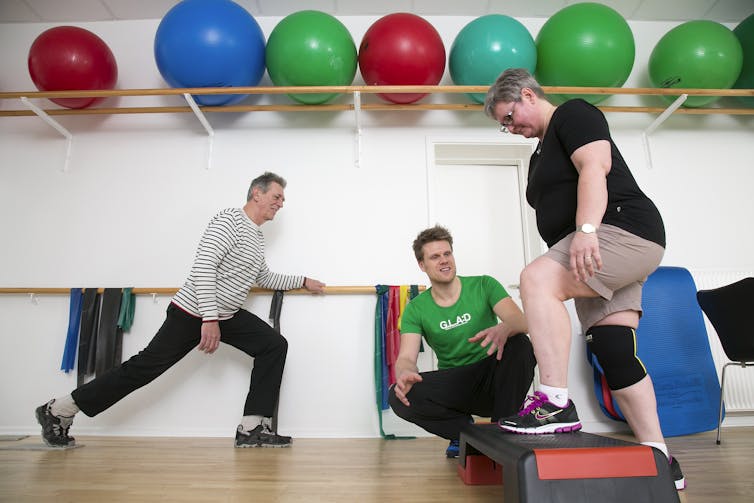
Earlier research also shows that people who exercise in groups, supervised by a physiotherapist, experience greater pain relief than those who exercise at home, unsupervised. Reasons for this difference may be that we work harder and dare to do more when guided by a physiotherapist with specialist knowledge.
To get the most from exercise, you should feel short of breath, or sweat a little, and increase the level of difficulty of the exercises as your body gets stronger.
Participants in the Danish GLAD study. Author provided
Two simple rules
You can exercise safely by following two simple pain rules. One, the pain you experience after exercise should be at a level that is tolerable. And, two, you shouldn’t experience any increase in pain from day to day.
Pain should be assessed daily after exercise on a zero-to-ten scale. On this scale, zero to two is considered “safe”, two to five “acceptable”, and five to ten “avoid”.
Let’s say your usual pain is three, and after exercising you rate it five. That’s fine. If your usual pain is three and after exercising you rate it a seven, you have done too much and should cut back the next time.
If your pain goes up to five after exercising, but the next morning is back at three – your usual morning pain – that’s fine. If your pain goes up to five after exercising, and is still at four or five the next morning (that is, more than your usual morning pain), you have done too much and should cut back. Keep at it, but at a lower level.
Exercising with arthritis
Interestingly, our research shows that it is safe to exercise with severe arthritis. When people with severe or bone-on-bone arthritis followed these two simple pain rules, 95% of all exercise sessions were performed with acceptable pain, and pain was relieved after a few weeks.
In a recent study, we enrolled people with mostly severe arthritis who fulfilled all the criteria to have a knee replacement op. All the participants received information on arthritis and its treatments, including self-help advice. They also took part in supervised exercise sessions twice weekly for eight weeks, and saw a dietitian if they were overweight.
Half of the participants were randomised to have their knee replaced. Among those not having their joint replaced immediately, only a quarter chose to have their joint replaced within a year. In other words, the pain relief that people experienced as a result of the exercise was enough for three-quarters of the participants to delay surgery for at least a year.
Exercise, especially when supervised, provides effective pain relief, but requires physical effort and sweat. Passive treatments, such as manual therapy, deep tissue massage and muscle stretches, given by a physiotherapist, doesn’t seem to work for people with hip or knee pain.